
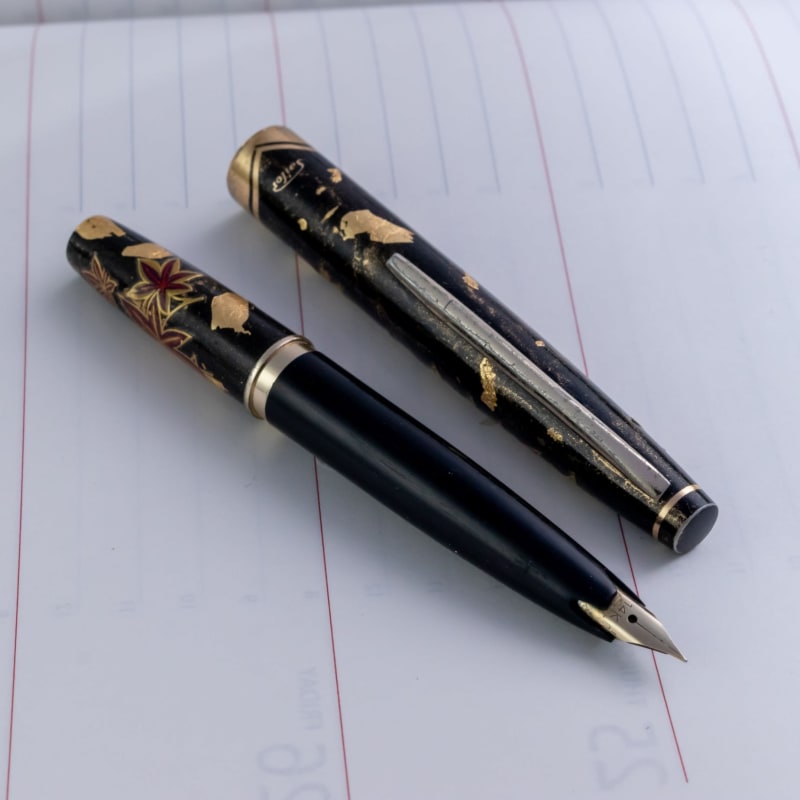



Vintage 1960s Sailor Momiji Ember Motif 14K Gold JIS Nib Pocket Fountain Pen
Condition: FineSku: NVF-NSK-555
$150.00 USD
Specifications
Brand: Sailor
Material: Gold, Metal
Filling mechanism: Converter or Cartridge (Sailor Proprietary Converter & Cartridge)
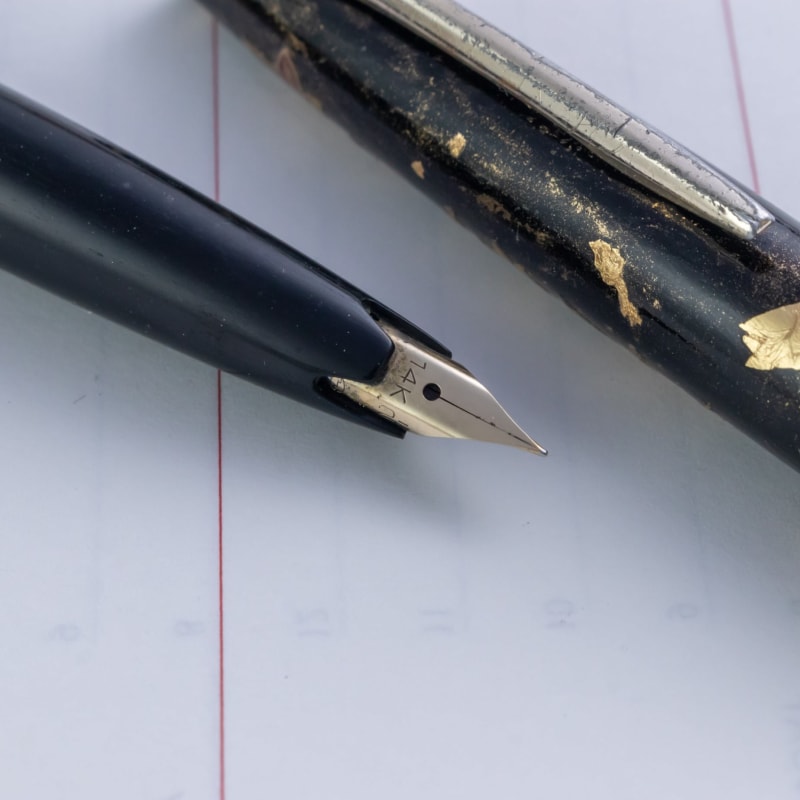
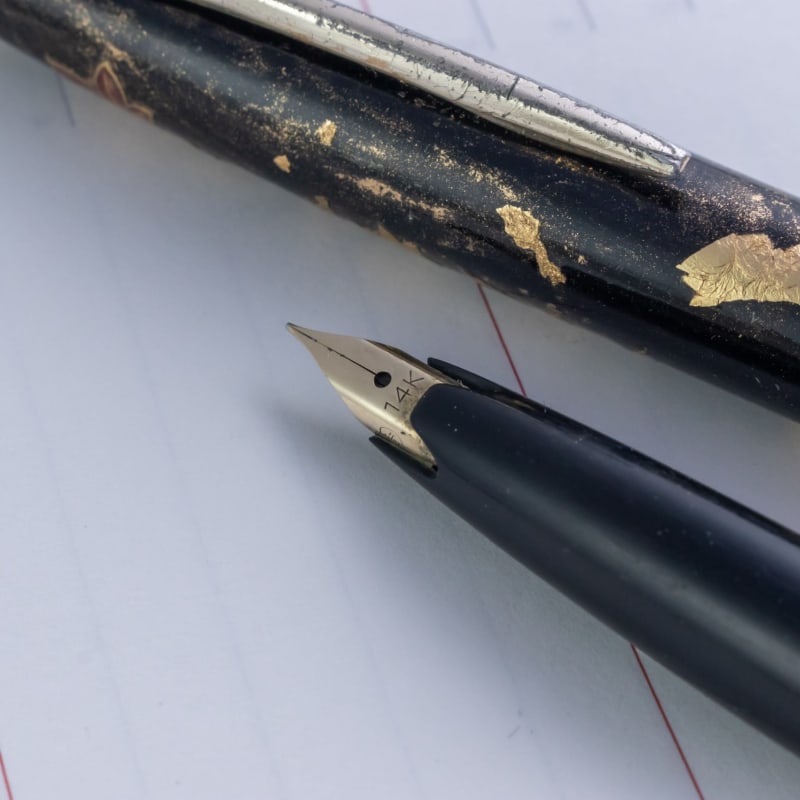
Nib: 14K Gold Nib
Feed: Plastic
Size: 110 mm (From the Cap) 93 mm (From the Nib) 145 mm (Capped Backwards)
Weight: 11 g
PRESENTATION
Pen and Box
Condition
The pen is in overall good condition, there are minor scratches found on the body of the pen. The is made out of resin.
There are no size marks on the nib, but it feels like an F-size one after test writing. And it is in pristine condition, with minimum to no ink stain whatsoever.
The nib, trim and clip of the pen was cleaned and polished, ready for its new owner to use it once again.
The pen is obtained by second-hand collectors market
This pen has been customized with Lacquer paint by our local housewives. We are not Urushi artisans and this is not an Urushi Lacquer fountain pen. It is a Lacquer paint that we use to decorate this pen adding a new aesthetic and new look. The artwork is done by our local artist.
This pen is a creative experiment and an artistic customization, not a traditional Urushi or artisan Maki-e piece. It is offered as a unique, one-of-a-kind art object meant to be enjoyed for its individuality, community story, and playful exploration of materials.
HISTORY
Founded in 1911, Sailor is the Japanese oldest pen maker and still making new and innovative pens today.
In the beginning, Sailor makes fountain pens with the classic eye droppers and lever piston filler mechanism fountain pens. famous and widely known as the innovator of the stationery world, in 1954 Sailor invented Japan's first ink cartridges and introduced them in 1958. Because ink cartridge allowed fountain pen to be operational without the long body, In 1963 Sailor invented the first compact portable chest pocket fountain pen that is both small and easy to use.
During that time, chest pocket pen was the latest fashion trend and because of the benefits from the ink cartridge technology, Sailor was able to create a portable fountain pen to accommodate the demand for small and elegant chest pocket pens
Over the year, Sailor chest pocket pens have evolved by changing the colors, expanding the nib variant, and improving the writability.
IN-HOUSE CUSTOMIZATION
This customization project was born from a simple but meaningful idea: to create beauty through everyday hands while supporting local households. In Japan, customization has long been a beloved part of hobby culture. From stationery to Gundam models and Tamiya cars, people enjoy repainting, decorating, and reimagining objects they already own. Customization is less about perfection and more about storytelling—about giving an object a new chapter and a renewed sense of life. In this project, local housewives participated directly in the creative process, allowing artistic work to be done within the community while providing support to local households.
The pen bodies are coated using modern lacquer paint rather than traditional Japanese Urushi lacquer. The work is carried out with care and creativity, but without the rigid formality of classical techniques. This choice allows for experimentation and accessibility, making it possible for non-artisans to participate meaningfully in the creation process. Each pen is then decorated using a combination of modern Maki-e stickers and gold, silver, and copper leaf, resulting in a one-of-a-kind surface that reflects both individual expression and collective effort.
MODERN LACQUER PAINT & MODERN MAKI-E STICKERS
Traditional Urushi lacquer and true hand-drawn Maki-e sit at the very top of Japanese decorative arts. Urushi is not simply paint—it is a living material that demands years, often decades, of training to control. Artisans apply layer after layer by hand, carefully curing and polishing each stage in humidity-controlled environments. Every line of Maki-e is drawn freehand with precious metal powders, where a single mistake cannot be undone. The process is slow, demanding, and exacting, but the result is extraordinary depth, durability, and cultural value that can last for generations.
This project takes a different path by design. Using modern lacquer paint and contemporary Maki-e style stickers allows for a more playful and expressive approach. The focus is on creativity, experimentation, and enjoyment. These modern methods invite freedom—combining metallic leaf, texture, and bold visuals to create something personal and unexpected. It is not about replacing tradition, but about exploring a lighter, more approachable way to celebrate art, imagination, and individuality.
DESIGN INSPIRATION: MOMIJI EMBER
Momiji Ember is a tribute to the fleeting beauty of the Japanese autumn. The deep black surface serves as a cold, late-season sky, providing a stark background for hand-painted Momiji (maple) leaves. These leaves are rendered in rich autumnal hues—deep burgundy, burnt orange, and touches of moss green—with fine golden veins that catch the light.
Interspersed with the foliage are heavy, weathered islands of metallic leaf, applied with a "fragmented" aesthetic. This creates the impression of embers rising from a bonfire or golden sunlight breaking through a dense canopy. The composition transitions from a quiet, understated foundation into a vibrant, textural masterpiece that celebrates the cycle of nature and the warmth of the hearth.
NIB PERFORMANCE
Not a surprise, the nib is a solid performer. With the 14K, the nib has amazing and consistent ink flow - with normal writing, there are no skips and hard starts. Sailor nibs are not typically scratchy, and this one is not, but they are known for their pencil-like feedback. I'm personally a fan of the feeling, it gives the nib some character, and the sensation of writing with it it's different than the ordinary super smooth 'buttery' nib. Nonetheless, it is very wet, awesome ink flow. With regular writing and no pressure, the nib and feed keep up easily with long writing sessions and fast writing. With some pressure, the nib does offer some line variations. Drying times are on the fast side, given the wetness and width of the nib. I found the feed dries out a little when you use some pressure, but of course, that's not what it is designed for. I am pleased that it wasn't skippy on smooth paper like Rhodia.
Specifications
Brand: Sailor
Material: Gold, Metal
Filling mechanism: Converter or Cartridge (Sailor Proprietary Converter & Cartridge)
Nib: 14K Gold Nib
Feed: Plastic
Size: 110 mm (From the Cap) 93 mm (From the Nib) 145 mm (Capped Backwards)
Weight: 11 g
PRESENTATION
Pen and Box
Condition
The pen is in overall good condition, there are minor scratches found on the body of the pen. The is made out of resin.
There are no size marks on the nib, but it feels like an F-size one after test writing. And it is in pristine condition, with minimum to no ink stain whatsoever.
The nib, trim and clip of the pen was cleaned and polished, ready for its new owner to use it once again.
The pen is obtained by second-hand collectors market
This pen has been customized with Lacquer paint by our local housewives. We are not Urushi artisans and this is not an Urushi Lacquer fountain pen. It is a Lacquer paint that we use to decorate this pen adding a new aesthetic and new look. The artwork is done by our local artist.
This pen is a creative experiment and an artistic customization, not a traditional Urushi or artisan Maki-e piece. It is offered as a unique, one-of-a-kind art object meant to be enjoyed for its individuality, community story, and playful exploration of materials.
HISTORY
Founded in 1911, Sailor is the Japanese oldest pen maker and still making new and innovative pens today.
In the beginning, Sailor makes fountain pens with the classic eye droppers and lever piston filler mechanism fountain pens. famous and widely known as the innovator of the stationery world, in 1954 Sailor invented Japan's first ink cartridges and introduced them in 1958. Because ink cartridge allowed fountain pen to be operational without the long body, In 1963 Sailor invented the first compact portable chest pocket fountain pen that is both small and easy to use.
During that time, chest pocket pen was the latest fashion trend and because of the benefits from the ink cartridge technology, Sailor was able to create a portable fountain pen to accommodate the demand for small and elegant chest pocket pens
Over the year, Sailor chest pocket pens have evolved by changing the colors, expanding the nib variant, and improving the writability.
IN-HOUSE CUSTOMIZATION
This customization project was born from a simple but meaningful idea: to create beauty through everyday hands while supporting local households. In Japan, customization has long been a beloved part of hobby culture. From stationery to Gundam models and Tamiya cars, people enjoy repainting, decorating, and reimagining objects they already own. Customization is less about perfection and more about storytelling—about giving an object a new chapter and a renewed sense of life. In this project, local housewives participated directly in the creative process, allowing artistic work to be done within the community while providing support to local households.
The pen bodies are coated using modern lacquer paint rather than traditional Japanese Urushi lacquer. The work is carried out with care and creativity, but without the rigid formality of classical techniques. This choice allows for experimentation and accessibility, making it possible for non-artisans to participate meaningfully in the creation process. Each pen is then decorated using a combination of modern Maki-e stickers and gold, silver, and copper leaf, resulting in a one-of-a-kind surface that reflects both individual expression and collective effort.
MODERN LACQUER PAINT & MODERN MAKI-E STICKERS
Traditional Urushi lacquer and true hand-drawn Maki-e sit at the very top of Japanese decorative arts. Urushi is not simply paint—it is a living material that demands years, often decades, of training to control. Artisans apply layer after layer by hand, carefully curing and polishing each stage in humidity-controlled environments. Every line of Maki-e is drawn freehand with precious metal powders, where a single mistake cannot be undone. The process is slow, demanding, and exacting, but the result is extraordinary depth, durability, and cultural value that can last for generations.
This project takes a different path by design. Using modern lacquer paint and contemporary Maki-e style stickers allows for a more playful and expressive approach. The focus is on creativity, experimentation, and enjoyment. These modern methods invite freedom—combining metallic leaf, texture, and bold visuals to create something personal and unexpected. It is not about replacing tradition, but about exploring a lighter, more approachable way to celebrate art, imagination, and individuality.
DESIGN INSPIRATION: MOMIJI EMBER
Momiji Ember is a tribute to the fleeting beauty of the Japanese autumn. The deep black surface serves as a cold, late-season sky, providing a stark background for hand-painted Momiji (maple) leaves. These leaves are rendered in rich autumnal hues—deep burgundy, burnt orange, and touches of moss green—with fine golden veins that catch the light.
Interspersed with the foliage are heavy, weathered islands of metallic leaf, applied with a "fragmented" aesthetic. This creates the impression of embers rising from a bonfire or golden sunlight breaking through a dense canopy. The composition transitions from a quiet, understated foundation into a vibrant, textural masterpiece that celebrates the cycle of nature and the warmth of the hearth.
NIB PERFORMANCE
Not a surprise, the nib is a solid performer. With the 14K, the nib has amazing and consistent ink flow - with normal writing, there are no skips and hard starts. Sailor nibs are not typically scratchy, and this one is not, but they are known for their pencil-like feedback. I'm personally a fan of the feeling, it gives the nib some character, and the sensation of writing with it it's different than the ordinary super smooth 'buttery' nib. Nonetheless, it is very wet, awesome ink flow. With regular writing and no pressure, the nib and feed keep up easily with long writing sessions and fast writing. With some pressure, the nib does offer some line variations. Drying times are on the fast side, given the wetness and width of the nib. I found the feed dries out a little when you use some pressure, but of course, that's not what it is designed for. I am pleased that it wasn't skippy on smooth paper like Rhodia.
Available Items
Vintage 1960s Sailor Momiji Ember Motif 14K Gold JIS Nib Pocket Fountain Pen
Condition: FineSku: NVF-NSK-555
$150.00 USD
Seller

Shipping
Ships From
Japan
Processing Time
3-5 days
Rates
Worldwide$25.00 (Free over $500.00)
Canada$25.00 (Free over $500.00)
European Union$25.00 (Free over $500.00)
Japan$10.00 (Free over $500.00)
Jordan$80.00
Kuwait$80.00
Lebanon$80.00
Oman$80.00
Qatar$80.00
Saudi Arabia$80.00
United Arab Emirates$80.00
United Kingdom$25.00 (Free over $500.00)
United States$25.00 (Free over $500.00)
Venezuela$80.00
Yemen$80.00
Vintage 1960s Sailor Momiji Ember Motif 14K Gold JIS Nib Pocket Fountain Pen
Condition: Fine
Specifications
Brand: Sailor
Material: Gold, Metal
Filling mechanism: Converter or Cartridge (Sailor Proprietary Converter & Cartridge)
Nib: 14K Gold Nib
Feed: Plastic
Size: 110 mm (From the Cap) 93 mm (From the Nib) 145 mm (Capped Backwards)
Weight: 11 g
PRESENTATION
Pen and Box
Condition
The pen is in overall good condition, there are minor scratches found on the body of the pen. The is made out of resin.
There are no size marks on the nib, but it feels like an F-size one after test writing. And it is in pristine condition, with minimum to no ink stain whatsoever.
The nib, trim and clip of the pen was cleaned and polished, ready for its new owner to use it once again.
The pen is obtained by second-hand collectors market
This pen has been customized with Lacquer paint by our local housewives. We are not Urushi artisans and this is not an Urushi Lacquer fountain pen. It is a Lacquer paint that we use to decorate this pen adding a new aesthetic and new look. The artwork is done by our local artist.
This pen is a creative experiment and an artistic customization, not a traditional Urushi or artisan Maki-e piece. It is offered as a unique, one-of-a-kind art object meant to be enjoyed for its individuality, community story, and playful exploration of materials.
HISTORY
Founded in 1911, Sailor is the Japanese oldest pen maker and still making new and innovative pens today.
In the beginning, Sailor makes fountain pens with the classic eye droppers and lever piston filler mechanism fountain pens. famous and widely known as the innovator of the stationery world, in 1954 Sailor invented Japan's first ink cartridges and introduced them in 1958. Because ink cartridge allowed fountain pen to be operational without the long body, In 1963 Sailor invented the first compact portable chest pocket fountain pen that is both small and easy to use.
During that time, chest pocket pen was the latest fashion trend and because of the benefits from the ink cartridge technology, Sailor was able to create a portable fountain pen to accommodate the demand for small and elegant chest pocket pens
Over the year, Sailor chest pocket pens have evolved by changing the colors, expanding the nib variant, and improving the writability.
IN-HOUSE CUSTOMIZATION
This customization project was born from a simple but meaningful idea: to create beauty through everyday hands while supporting local households. In Japan, customization has long been a beloved part of hobby culture. From stationery to Gundam models and Tamiya cars, people enjoy repainting, decorating, and reimagining objects they already own. Customization is less about perfection and more about storytelling—about giving an object a new chapter and a renewed sense of life. In this project, local housewives participated directly in the creative process, allowing artistic work to be done within the community while providing support to local households.
The pen bodies are coated using modern lacquer paint rather than traditional Japanese Urushi lacquer. The work is carried out with care and creativity, but without the rigid formality of classical techniques. This choice allows for experimentation and accessibility, making it possible for non-artisans to participate meaningfully in the creation process. Each pen is then decorated using a combination of modern Maki-e stickers and gold, silver, and copper leaf, resulting in a one-of-a-kind surface that reflects both individual expression and collective effort.
MODERN LACQUER PAINT & MODERN MAKI-E STICKERS
Traditional Urushi lacquer and true hand-drawn Maki-e sit at the very top of Japanese decorative arts. Urushi is not simply paint—it is a living material that demands years, often decades, of training to control. Artisans apply layer after layer by hand, carefully curing and polishing each stage in humidity-controlled environments. Every line of Maki-e is drawn freehand with precious metal powders, where a single mistake cannot be undone. The process is slow, demanding, and exacting, but the result is extraordinary depth, durability, and cultural value that can last for generations.
This project takes a different path by design. Using modern lacquer paint and contemporary Maki-e style stickers allows for a more playful and expressive approach. The focus is on creativity, experimentation, and enjoyment. These modern methods invite freedom—combining metallic leaf, texture, and bold visuals to create something personal and unexpected. It is not about replacing tradition, but about exploring a lighter, more approachable way to celebrate art, imagination, and individuality.
DESIGN INSPIRATION: MOMIJI EMBER
Momiji Ember is a tribute to the fleeting beauty of the Japanese autumn. The deep black surface serves as a cold, late-season sky, providing a stark background for hand-painted Momiji (maple) leaves. These leaves are rendered in rich autumnal hues—deep burgundy, burnt orange, and touches of moss green—with fine golden veins that catch the light.
Interspersed with the foliage are heavy, weathered islands of metallic leaf, applied with a "fragmented" aesthetic. This creates the impression of embers rising from a bonfire or golden sunlight breaking through a dense canopy. The composition transitions from a quiet, understated foundation into a vibrant, textural masterpiece that celebrates the cycle of nature and the warmth of the hearth.
NIB PERFORMANCE
Not a surprise, the nib is a solid performer. With the 14K, the nib has amazing and consistent ink flow - with normal writing, there are no skips and hard starts. Sailor nibs are not typically scratchy, and this one is not, but they are known for their pencil-like feedback. I'm personally a fan of the feeling, it gives the nib some character, and the sensation of writing with it it's different than the ordinary super smooth 'buttery' nib. Nonetheless, it is very wet, awesome ink flow. With regular writing and no pressure, the nib and feed keep up easily with long writing sessions and fast writing. With some pressure, the nib does offer some line variations. Drying times are on the fast side, given the wetness and width of the nib. I found the feed dries out a little when you use some pressure, but of course, that's not what it is designed for. I am pleased that it wasn't skippy on smooth paper like Rhodia.
Specifications
Brand: Sailor
Material: Gold, Metal
Filling mechanism: Converter or Cartridge (Sailor Proprietary Converter & Cartridge)
Nib: 14K Gold Nib
Feed: Plastic
Size: 110 mm (From the Cap) 93 mm (From the Nib) 145 mm (Capped Backwards)
Weight: 11 g
PRESENTATION
Pen and Box
Condition
The pen is in overall good condition, there are minor scratches found on the body of the pen. The is made out of resin.
There are no size marks on the nib, but it feels like an F-size one after test writing. And it is in pristine condition, with minimum to no ink stain whatsoever.
The nib, trim and clip of the pen was cleaned and polished, ready for its new owner to use it once again.
The pen is obtained by second-hand collectors market
This pen has been customized with Lacquer paint by our local housewives. We are not Urushi artisans and this is not an Urushi Lacquer fountain pen. It is a Lacquer paint that we use to decorate this pen adding a new aesthetic and new look. The artwork is done by our local artist.
This pen is a creative experiment and an artistic customization, not a traditional Urushi or artisan Maki-e piece. It is offered as a unique, one-of-a-kind art object meant to be enjoyed for its individuality, community story, and playful exploration of materials.
HISTORY
Founded in 1911, Sailor is the Japanese oldest pen maker and still making new and innovative pens today.
In the beginning, Sailor makes fountain pens with the classic eye droppers and lever piston filler mechanism fountain pens. famous and widely known as the innovator of the stationery world, in 1954 Sailor invented Japan's first ink cartridges and introduced them in 1958. Because ink cartridge allowed fountain pen to be operational without the long body, In 1963 Sailor invented the first compact portable chest pocket fountain pen that is both small and easy to use.
During that time, chest pocket pen was the latest fashion trend and because of the benefits from the ink cartridge technology, Sailor was able to create a portable fountain pen to accommodate the demand for small and elegant chest pocket pens
Over the year, Sailor chest pocket pens have evolved by changing the colors, expanding the nib variant, and improving the writability.
IN-HOUSE CUSTOMIZATION
This customization project was born from a simple but meaningful idea: to create beauty through everyday hands while supporting local households. In Japan, customization has long been a beloved part of hobby culture. From stationery to Gundam models and Tamiya cars, people enjoy repainting, decorating, and reimagining objects they already own. Customization is less about perfection and more about storytelling—about giving an object a new chapter and a renewed sense of life. In this project, local housewives participated directly in the creative process, allowing artistic work to be done within the community while providing support to local households.
The pen bodies are coated using modern lacquer paint rather than traditional Japanese Urushi lacquer. The work is carried out with care and creativity, but without the rigid formality of classical techniques. This choice allows for experimentation and accessibility, making it possible for non-artisans to participate meaningfully in the creation process. Each pen is then decorated using a combination of modern Maki-e stickers and gold, silver, and copper leaf, resulting in a one-of-a-kind surface that reflects both individual expression and collective effort.
MODERN LACQUER PAINT & MODERN MAKI-E STICKERS
Traditional Urushi lacquer and true hand-drawn Maki-e sit at the very top of Japanese decorative arts. Urushi is not simply paint—it is a living material that demands years, often decades, of training to control. Artisans apply layer after layer by hand, carefully curing and polishing each stage in humidity-controlled environments. Every line of Maki-e is drawn freehand with precious metal powders, where a single mistake cannot be undone. The process is slow, demanding, and exacting, but the result is extraordinary depth, durability, and cultural value that can last for generations.
This project takes a different path by design. Using modern lacquer paint and contemporary Maki-e style stickers allows for a more playful and expressive approach. The focus is on creativity, experimentation, and enjoyment. These modern methods invite freedom—combining metallic leaf, texture, and bold visuals to create something personal and unexpected. It is not about replacing tradition, but about exploring a lighter, more approachable way to celebrate art, imagination, and individuality.
DESIGN INSPIRATION: MOMIJI EMBER
Momiji Ember is a tribute to the fleeting beauty of the Japanese autumn. The deep black surface serves as a cold, late-season sky, providing a stark background for hand-painted Momiji (maple) leaves. These leaves are rendered in rich autumnal hues—deep burgundy, burnt orange, and touches of moss green—with fine golden veins that catch the light.
Interspersed with the foliage are heavy, weathered islands of metallic leaf, applied with a "fragmented" aesthetic. This creates the impression of embers rising from a bonfire or golden sunlight breaking through a dense canopy. The composition transitions from a quiet, understated foundation into a vibrant, textural masterpiece that celebrates the cycle of nature and the warmth of the hearth.
NIB PERFORMANCE
Not a surprise, the nib is a solid performer. With the 14K, the nib has amazing and consistent ink flow - with normal writing, there are no skips and hard starts. Sailor nibs are not typically scratchy, and this one is not, but they are known for their pencil-like feedback. I'm personally a fan of the feeling, it gives the nib some character, and the sensation of writing with it it's different than the ordinary super smooth 'buttery' nib. Nonetheless, it is very wet, awesome ink flow. With regular writing and no pressure, the nib and feed keep up easily with long writing sessions and fast writing. With some pressure, the nib does offer some line variations. Drying times are on the fast side, given the wetness and width of the nib. I found the feed dries out a little when you use some pressure, but of course, that's not what it is designed for. I am pleased that it wasn't skippy on smooth paper like Rhodia.
Add items to purchase or make an offer
Seller
Shipping
Ships From
Japan
Processing Time
3-5 days
Rates
Worldwide$25.00 (Free over $500.00)
Canada$25.00 (Free over $500.00)
European Union$25.00 (Free over $500.00)
Japan$10.00 (Free over $500.00)
Jordan$80.00
Kuwait$80.00
Lebanon$80.00
Oman$80.00
Qatar$80.00
Saudi Arabia$80.00
United Arab Emirates$80.00
United Kingdom$25.00 (Free over $500.00)
United States$25.00 (Free over $500.00)
Venezuela$80.00
Yemen$80.00
Ask a question or make a comment
Please log in to leave a comment