
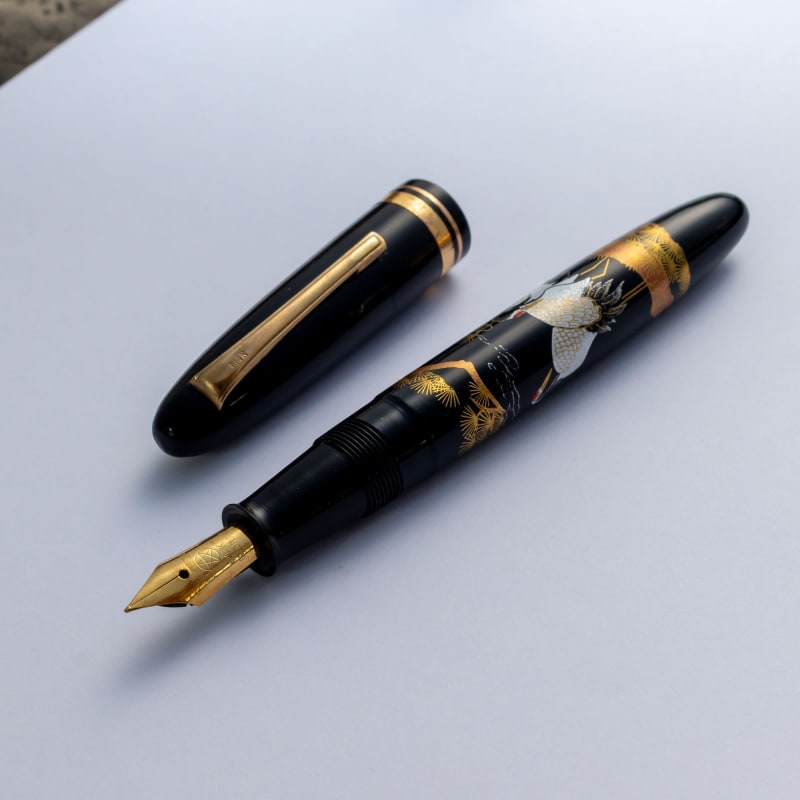




Nishio Urushi Ebonite Kindai Maki-e Crane Fountain Pen 14KT Iridium Nib
Condition: ExcellentNib: Fine (F)Sku: NP-EB-CR2
$315.00 USD
Specifications
Brand: Nishio
Model: Ebonite Urushi Crane Kindai Maki-e
Era: 1930s - 1950s
Body Material: Ebonite, Urushi
Filling System: Tomeshiki Filler Mechanism
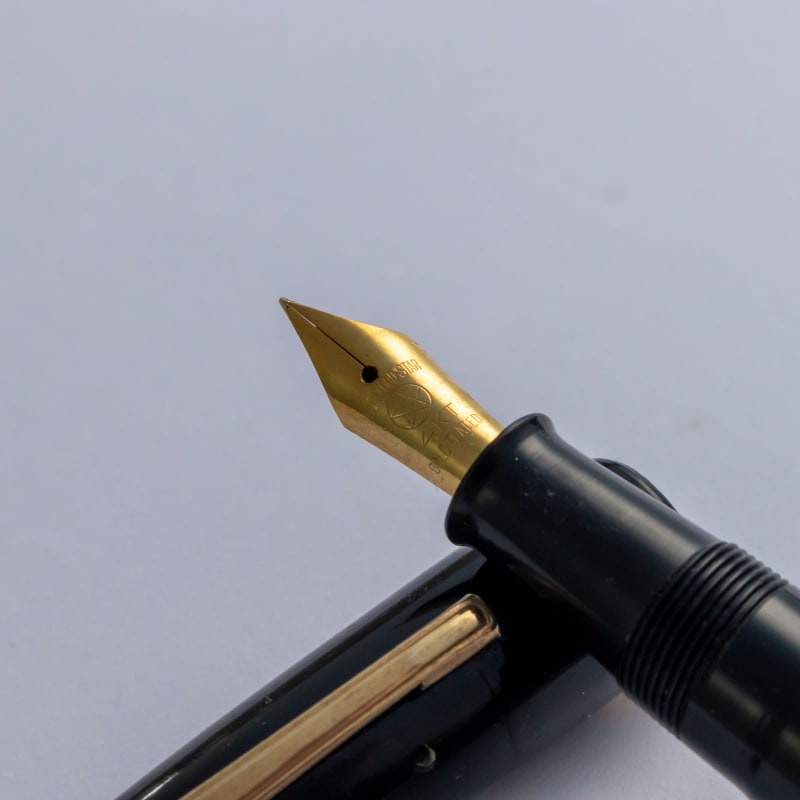
Nib: 14KT Hollywood Star Iridium Nib]
Color: Black
Length: 132 mm
Weight: 16.55
PRESENTATION
Pen + Box
Condition
In Mint Condition!
There are minimal wear and tear on the cap and the sac have be replaced and tested
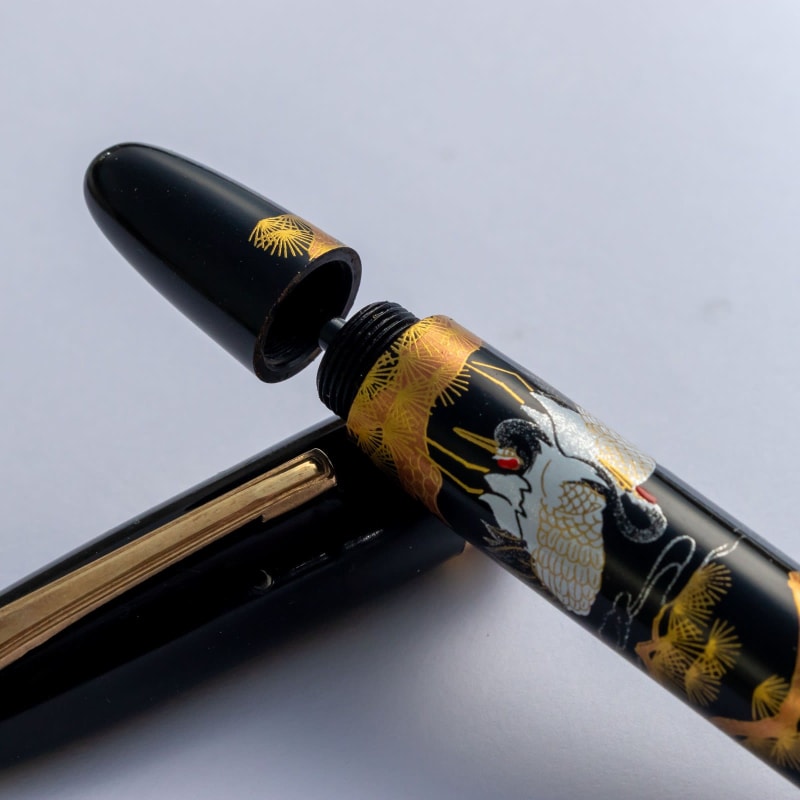
The whole pen is made out of Black ebonite body construction and has been customized by applying Kindai Maki-e print by Oshita Art Studio Maki-e
History of Nishio Seisakujo Private Collection
Renowned Japanese fountain pen manufacturer "NISHIO SEISHAKUSHO" crafted this in Osaka, one of Japan's largest cities. "NISHIO SEISHAKUSHO" embarked on its journey in the early 1900s and it is a testament to its legacy that it continues to be one of the most popular brands despite no longer being operational. The company's president and owner, eighty-four-year-old Mr. Zero Nishio holds the esteemed position of being considered one of Osaka's intellectual figures in the stationary revolution that followed World War II.
During that era, numerous distinctive pens were manufactured and sold by three prominent giants in the industry: Pilot, Sailor, and Platinum. Japan experienced unprecedented economic growth throughout the country, leading to the establishment of several stationary factories that, sadly, no longer exist today. In this regard, I am delighted to present a pen that originated in 1940s Osaka, Japan--a remarkable piece of history that is no longer readily available.
This pen carries the history of the Nishio Fountain pen for more than eighty years.
This pen is a piece of fountain pen history that you have the chance to possess.
ABOUT MR NISHIO'S OSAKA STATIONERY COLLECTION
Mr. Nishio was one of the prominent fountain pen sellers from the 1900s with a vast collection of ebonite and celluloid fountain pens. Mr. Nishio is also known to not only sell his own fountain pens but also make fountain pens for other companies. However, his endeavor came to an end when the war broke out and forced him to close down. His remaining collection was kept in the depository for a long time. Recently we were able to get a hold of his private collection which was in great condition! The supreme quality of his collection forces us to list the item for it to find a new home.
Urushi Kindai maki-e by oshita art studio lacquer house
Kindai Maki-e, or Modern Maki-e, is a contemporary interpretation of the traditional Japanese art form of Maki-e. Maki-e involves decorating lacquerware or other surfaces with intricate designs using powdered metals, typically gold and silver, as well as other materials like crushed seashells and gemstones. These designs are created by skilled artisans who painstakingly apply these materials to the surface and then lacquer over them multiple times to create a smooth, durable finish. Kindai Maki-e However provides an alternative method to the famous art craft. Instead of painting and decorating the pen with a paintbrush by hand, the Modern Maki-e technique uses digitally printed Maki-e designs on to a surface area. Can be a pen, bowl, laptop, or phone. However, how Oshita Art Studio Does Modern Maki-e takes it to the next level. They use screen printing and print the maki-e design onto the pen using thin layers of screen print papers and then coated with a thin layer of urushi and later decorated with Gold powder and Silver Powder by hand to add an extra touch to the pen.
The crane motif depicted in this Urushi maki-e design carries a profound and enduring significance within Japanese art and culture. Gracefully rendered in gold and silver tones against a deep lacquered surface, the cranes appear in mid-flight, evoking a sense of movement, harmony, and quiet elegance. In Japanese tradition, the crane (tsuru) is revered as a symbol of longevity, good fortune, and fidelity, often associated with wishes for a thousand years of happiness.
Executed using the traditional maki-e technique, fine metallic powders are carefully sprinkled over layers of urushi lacquer to bring each crane to life with subtle brilliance and depth. The contrast between the shimmering forms and the dark lacquer ground enhances the sense of refinement, allowing the motif to shift gently with light and perspective. Each bird is not merely decorative, but part of a flowing composition that reflects balance and continuity.
Historically, cranes have appeared in textiles, screens, and lacquerware as auspicious symbols, often gifted to mark important life moments. In this design, their repeated flight pattern suggests unity and enduring connection, making the piece both visually striking and culturally meaningful. The result is a timeless expression of Japanese aesthetics--where nature, symbolism, and craftsmanship come together in quiet sophistication.
14KT Gold-Plated Hollywood Star Iridium Nib
The 14KT Gold-Plated Hollywood Star Iridium nib is a decorative yet functional nib commonly found on vintage-inspired or mass-produced fountain pens. Unlike solid gold nibs, this nib is typically made from a base metal (usually stainless steel) and finished with a layer of 14K gold plating, giving it the warm appearance of gold while maintaining durability and affordability.
The “Iridium” designation refers to the hard tipping material applied to the nib’s writing point, which is designed for long-lasting performance. While historically true iridium was used, modern nibs use a durable alloy from the platinum group of metals to achieve the same wear resistance and smoothness . This tipping ensures the nib can withstand regular writing without wearing down quickly.
The “Hollywood Star” marking is primarily a branding or stylistic engraving, often used to give the nib a more premium or distinctive identity rather than indicating a specific manufacturer or gold content standard. Similarly, terms like “14KT Gold-Plated” should not be confused with solid 14K gold--this refers only to the surface finish, not the core material.
In writing performance, these nibs are generally firm, reliable, and smooth, offering consistent ink flow and a controlled feel on paper. They are well-suited for everyday use, especially for those who prefer durability and low maintenance over the softer, more responsive feel of solid gold nibs.
Overall, the 14KT Gold-Plated Hollywood Star Iridium nib represents a practical and visually appealing option, combining classic gold aesthetics with modern durability and dependable writing performance.
HOW TO USE
The Tomeshiki Filler System (or the Ink Stopper Filler System) functions similiarly to a eyedropper, the piston at the back is a mechanism that stops or allows the ink to flow into the nib. It is a old Japanese Filler Mechanism that have been disregarded as time passed for more easier ink access. Even we ourselve have discovered this type of filler found only in Japanese made Vintage pens.
To use the pen
Unscrew the grip section to separate it from the barrel.
Use an eyedropper to inject ink directly into the barrel
Reattach the grip section securely.
Once sealed, turn the piston knob (at the end of the barrel) counterclockwise to open the ink stopper.
Hold the pen nib-down to allow ink to flow into the feed. After a few minutes, the pen should begin to write.
Turn the piston clockwise again to close the ink stopper.
If the ink in the feed runs out, simply repeat step 4 to allow more ink to flow in.
Available Items
Nishio Urushi Ebonite Kindai Maki-e Crane Fountain Pen 14KT Iridium Nib
Condition: ExcellentNib: Fine (F)Sku: NP-EB-CR2
$315.00 USD
Seller

EngeikaShop
Takada, Japan
1 sale
Verified by PayPal
Verified Business
Reddit Verified
Shipping
Ships From
Japan
Processing Time
3-5 days
Rates
Worldwide$26.25 (Free over $500.00)
Canada$26.25 (Free over $500.00)
European Union$26.25 (Free over $500.00)
Japan$10.50 (Free over $500.00)
Jordan$84.00
Kuwait$84.00
Lebanon$84.00
Oman$84.00
Qatar$84.00
Saudi Arabia$84.00
Switzerland$26.25 (Free over $500.00)
United Arab Emirates$84.00
United Kingdom$26.25 (Free over $500.00)
United States$26.25 (Free over $500.00)
Venezuela$84.00
Yemen$84.00
Nishio Urushi Ebonite Kindai Maki-e Crane Fountain Pen 14KT Iridium Nib
Condition: ExcellentNib: Fine (F)
Specifications
Brand: Nishio
Model: Ebonite Urushi Crane Kindai Maki-e
Era: 1930s - 1950s
Body Material: Ebonite, Urushi
Filling System: Tomeshiki Filler Mechanism
Nib: 14KT Hollywood Star Iridium Nib]
Color: Black
Length: 132 mm
Weight: 16.55
PRESENTATION
Pen + Box
Condition
In Mint Condition!
There are minimal wear and tear on the cap and the sac have be replaced and tested
The whole pen is made out of Black ebonite body construction and has been customized by applying Kindai Maki-e print by Oshita Art Studio Maki-e
History of Nishio Seisakujo Private Collection
Renowned Japanese fountain pen manufacturer "NISHIO SEISHAKUSHO" crafted this in Osaka, one of Japan's largest cities. "NISHIO SEISHAKUSHO" embarked on its journey in the early 1900s and it is a testament to its legacy that it continues to be one of the most popular brands despite no longer being operational. The company's president and owner, eighty-four-year-old Mr. Zero Nishio holds the esteemed position of being considered one of Osaka's intellectual figures in the stationary revolution that followed World War II.
During that era, numerous distinctive pens were manufactured and sold by three prominent giants in the industry: Pilot, Sailor, and Platinum. Japan experienced unprecedented economic growth throughout the country, leading to the establishment of several stationary factories that, sadly, no longer exist today. In this regard, I am delighted to present a pen that originated in 1940s Osaka, Japan--a remarkable piece of history that is no longer readily available.
This pen carries the history of the Nishio Fountain pen for more than eighty years.
This pen is a piece of fountain pen history that you have the chance to possess.
ABOUT MR NISHIO'S OSAKA STATIONERY COLLECTION
Mr. Nishio was one of the prominent fountain pen sellers from the 1900s with a vast collection of ebonite and celluloid fountain pens. Mr. Nishio is also known to not only sell his own fountain pens but also make fountain pens for other companies. However, his endeavor came to an end when the war broke out and forced him to close down. His remaining collection was kept in the depository for a long time. Recently we were able to get a hold of his private collection which was in great condition! The supreme quality of his collection forces us to list the item for it to find a new home.
Urushi Kindai maki-e by oshita art studio lacquer house
Kindai Maki-e, or Modern Maki-e, is a contemporary interpretation of the traditional Japanese art form of Maki-e. Maki-e involves decorating lacquerware or other surfaces with intricate designs using powdered metals, typically gold and silver, as well as other materials like crushed seashells and gemstones. These designs are created by skilled artisans who painstakingly apply these materials to the surface and then lacquer over them multiple times to create a smooth, durable finish. Kindai Maki-e However provides an alternative method to the famous art craft. Instead of painting and decorating the pen with a paintbrush by hand, the Modern Maki-e technique uses digitally printed Maki-e designs on to a surface area. Can be a pen, bowl, laptop, or phone. However, how Oshita Art Studio Does Modern Maki-e takes it to the next level. They use screen printing and print the maki-e design onto the pen using thin layers of screen print papers and then coated with a thin layer of urushi and later decorated with Gold powder and Silver Powder by hand to add an extra touch to the pen.
The crane motif depicted in this Urushi maki-e design carries a profound and enduring significance within Japanese art and culture. Gracefully rendered in gold and silver tones against a deep lacquered surface, the cranes appear in mid-flight, evoking a sense of movement, harmony, and quiet elegance. In Japanese tradition, the crane (tsuru) is revered as a symbol of longevity, good fortune, and fidelity, often associated with wishes for a thousand years of happiness.
Executed using the traditional maki-e technique, fine metallic powders are carefully sprinkled over layers of urushi lacquer to bring each crane to life with subtle brilliance and depth. The contrast between the shimmering forms and the dark lacquer ground enhances the sense of refinement, allowing the motif to shift gently with light and perspective. Each bird is not merely decorative, but part of a flowing composition that reflects balance and continuity.
Historically, cranes have appeared in textiles, screens, and lacquerware as auspicious symbols, often gifted to mark important life moments. In this design, their repeated flight pattern suggests unity and enduring connection, making the piece both visually striking and culturally meaningful. The result is a timeless expression of Japanese aesthetics--where nature, symbolism, and craftsmanship come together in quiet sophistication.
14KT Gold-Plated Hollywood Star Iridium Nib
The 14KT Gold-Plated Hollywood Star Iridium nib is a decorative yet functional nib commonly found on vintage-inspired or mass-produced fountain pens. Unlike solid gold nibs, this nib is typically made from a base metal (usually stainless steel) and finished with a layer of 14K gold plating, giving it the warm appearance of gold while maintaining durability and affordability.
The “Iridium” designation refers to the hard tipping material applied to the nib’s writing point, which is designed for long-lasting performance. While historically true iridium was used, modern nibs use a durable alloy from the platinum group of metals to achieve the same wear resistance and smoothness . This tipping ensures the nib can withstand regular writing without wearing down quickly.
The “Hollywood Star” marking is primarily a branding or stylistic engraving, often used to give the nib a more premium or distinctive identity rather than indicating a specific manufacturer or gold content standard. Similarly, terms like “14KT Gold-Plated” should not be confused with solid 14K gold--this refers only to the surface finish, not the core material.
In writing performance, these nibs are generally firm, reliable, and smooth, offering consistent ink flow and a controlled feel on paper. They are well-suited for everyday use, especially for those who prefer durability and low maintenance over the softer, more responsive feel of solid gold nibs.
Overall, the 14KT Gold-Plated Hollywood Star Iridium nib represents a practical and visually appealing option, combining classic gold aesthetics with modern durability and dependable writing performance.
HOW TO USE
The Tomeshiki Filler System (or the Ink Stopper Filler System) functions similiarly to a eyedropper, the piston at the back is a mechanism that stops or allows the ink to flow into the nib. It is a old Japanese Filler Mechanism that have been disregarded as time passed for more easier ink access. Even we ourselve have discovered this type of filler found only in Japanese made Vintage pens.
To use the pen
Unscrew the grip section to separate it from the barrel.
Use an eyedropper to inject ink directly into the barrel
Reattach the grip section securely.
Once sealed, turn the piston knob (at the end of the barrel) counterclockwise to open the ink stopper.
Hold the pen nib-down to allow ink to flow into the feed. After a few minutes, the pen should begin to write.
Turn the piston clockwise again to close the ink stopper.
If the ink in the feed runs out, simply repeat step 4 to allow more ink to flow in.
Updating your total…
Seller
EngeikaShop
Takada, Japan
1 sale
Verified by PayPal
Verified Business
Reddit Verified
Shipping
Ships From
Japan
Processing Time
3-5 days
Rates
Worldwide$26.25 (Free over $500.00)
Canada$26.25 (Free over $500.00)
European Union$26.25 (Free over $500.00)
Japan$10.50 (Free over $500.00)
Jordan$84.00
Kuwait$84.00
Lebanon$84.00
Oman$84.00
Qatar$84.00
Saudi Arabia$84.00
Switzerland$26.25 (Free over $500.00)
United Arab Emirates$84.00
United Kingdom$26.25 (Free over $500.00)
United States$26.25 (Free over $500.00)
Venezuela$84.00
Yemen$84.00
Ask a question or make a comment
Please log in to leave a comment